A small or mid-sized business can now run an AI sales agent for under €150/month in tooling, wherever it sells. No heavy technical team required: the n8n + Claude + CRM stack qualifies your leads, follows up automatically and answers common objections, whereas the agents built into large CRMs (such as Salesforce Agentforce) come on top of an already expensive CRM licence.
Here are the architecture, the cost of each tool and the steps to get started.
À retenir — Key Takeaways
- Tooling cost: €50–137/month (n8n ~€20, Claude API €30–80 depending on volume, CRM free or up to €30, Brevo €0–7)
- 3 use cases: inbound lead qualification, context-aware follow-ups, pre-sale replies
- First workflow: lead qualification, up and running in about 48 hours of work
- Compatibility: HubSpot, Pipedrive, Salesforce, Notion, Airtable + any tool with a webhook or API
- What to measure: time to first response, first-meeting rate, share of leads wrongly passed to sales
- Limit: the agent prepares and follows up; closing and key accounts stay human
What is an AI sales agent (and why it changes everything)?
An AI sales agent automatically handles part of your sales cycle: lead qualification, smart follow-ups, objection handling, appointment booking.
The fundamental difference from classic automation:
- Classic automation: if email received → send predefined template
- AI agent: analyze the prospect's intent, adapt the message based on CRM context, decide to follow up or escalate to a human
This is exactly what Salesforce Agentforce offers. But since 2025, the same capabilities are accessible to SMBs via n8n and Claude — for a fraction of the budget.
n8n + Claude + CRM stack: architecture and real costs
This architecture suits B2B SMBs (services, SaaS, consulting) that receive leads through a form or by email, from a few dozen to several hundred a month, in any market.
Simplified architecture:
Form / Inbound email
       ↓
      n8n  (workflow orchestration)
       ↓
    Claude API  (analysis, scoring, copywriting)
       ↓
      CRM  (update + commercial routing)
       ↓
  Email / Slack / Sales action
The 4 stack tools
n8n — orchestration (~€20/month cloud, free self-hosted)
Connects your tools, orchestrates steps, manages conditions and follow-up loops. Key strengths: open source, native HTTP node to call Claude, full execution logging.
Claude API — commercial intelligence (€30 to €80/month depending on volume)
Analyzes inbound leads, scores their purchase potential, writes personalized follow-ups, handles objections. A mid-range model (the Sonnet family) is enough for these repetitive tasks; keep the more expensive models for complex cases.
HubSpot or Pipedrive — CRM (€0 to €30/month)
Centralizes prospect data, triggers n8n workflows via webhooks, tracks each commercial interaction.
Brevo — emailing (€0 to €7/month)
Transactional sending + open tracking to trigger smart follow-ups.
Total tooling cost: €50 to €137/month, excluding setup time. For a complete breakdown of AI automation costs, see real prices for SMBs in 2026.
3 concrete use cases (typical scenarios)
1. Automatic inbound lead qualification
The most common bottleneck in B2B SMBs: leads come in, then wait hours, sometimes days, before anyone qualifies them and calls back.
Typical workflow:
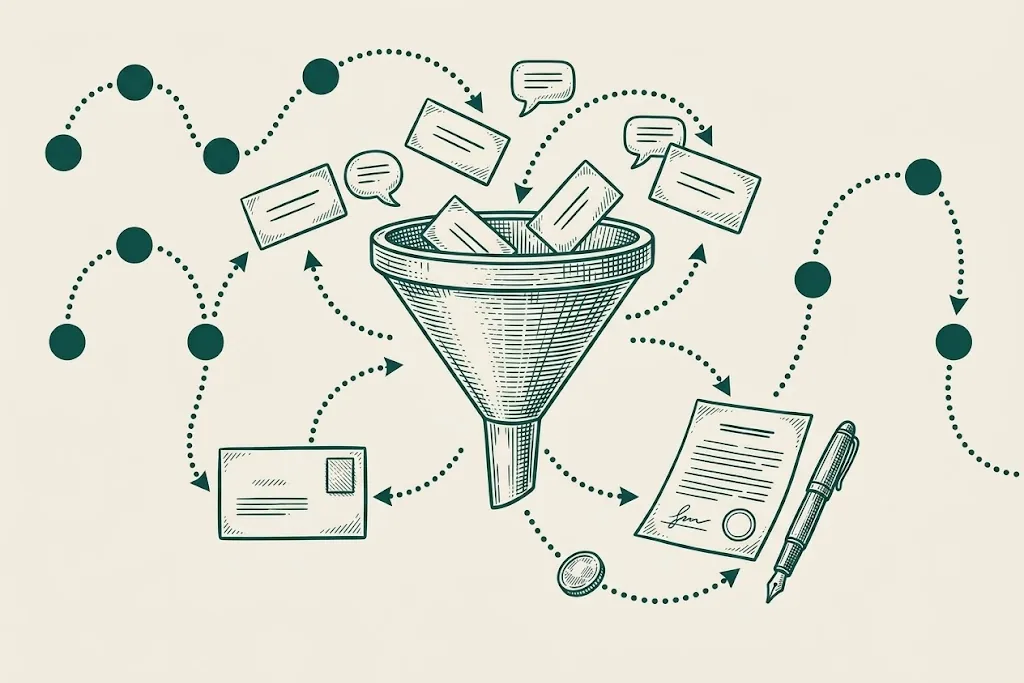
- Form or inbound email triggers an n8n webhook
- Lead enrichment (LinkedIn Sales Navigator API or Clearbit)
- Claude analyzes the message: sector, company size, urgency, intent signal
- Score 1 to 10 with a 3-line summary for the salesperson
- Personalized response sent to the prospect in under 3 minutes
- If score ≥ 7: automatic deal creation in CRM + Slack notification to the salesperson
What to measure:
- Average time between a lead arriving and the first reply
- Share of leads that get a first meeting
- Share of leads passed to sales that shouldn't have been (score false positives)
2. Smart commercial follow-ups
Manual follow-up is the task salespeople hate most — and neglect most. An AI agent does it systematically, without forgetting, without discouragement.
Typical workflow:
- n8n scans the CRM daily: deals with no activity in the last N days
- Full context retrieval: emails exchanged, CRM notes, last action
- Claude generates a contextualized follow-up — not a template, a follow-up that references the real context
- Sent at the optimal moment (analysis of previous open times)
- If opened without reply → escalation with notification to the responsible salesperson
What to measure:
- Follow-up reply rate, compared with manual follow-ups
- Number of followed-up deals that come back into the pipeline
3. Automated pre-sale commercial support
Prospects often ask the same questions: price, timelines, ROI, comparison with competitors. An AI agent can answer the most frequent ones and hand over the rest.
Typical workflow:
- Email or contact form → automatic classification (price request, objection, comparison, technical question)
- Claude responds from a structured knowledge base (offers, terms, common objections)
- If the request exceeds scope → automatic meeting proposal via Calendly
- Everything is tracked in the CRM for the salesperson to take over if needed
What to measure:
- Share of pre-sale requests handled without human intervention
- Replies corrected or taken over by a salesperson (knowledge base quality)
A Note on GDPR and Data Handling
Sending lead emails and CRM notes to a third-party LLM API raises a legitimate question, especially if you sell to customers in the EU: is this GDPR-compliant? In practice, yes, provided a few safeguards are in place. Anthropic offers a data processing addendum covering standard contractual clauses for EU customers, and API usage is not used to train models by default. On the n8n side, self-hosting the orchestration layer keeps workflow logs and stored credentials inside your own infrastructure rather than a third-party cloud.
The practical checklist before going live: sign the data processing addendum with your LLM provider, document the processing in your data register, mask or exclude highly sensitive fields such as payment details or health data from prompts, and set a retention window on stored lead transcripts, with 12 months a common default. None of this requires a data protection officer or a six-figure compliance budget — a half-day review with whoever already manages your CRM's data policy is usually enough.
How to deploy your first AI agent (4 steps)
At NeuraWeb, we always recommend starting with a single use case — then scaling.
Step 1 — Identify your bottleneck
Slow qualification? Forgotten follow-ups? Repetitive pre-sale questions? Choose the problem costing the most in sales time today.
Step 2 — Connect your CRM to n8n (2 to 4 hours)
HubSpot, Pipedrive and Salesforce have native nodes in n8n. OAuth connection takes 30 minutes. Configuring the trigger webhook: 1 to 2 hours.
Step 3 — Configure Claude prompts
This is the critical step. The prompt must include: your ICP (ideal customer profile), your offers, common objections and their standard response, the desired commercial tone. A good qualification prompt is 300 to 500 tokens — no more.
Step 4 — Test on 10% of leads, then scale
Don't switch 100% of volume on day one. Test on a subset, measure output quality, refine the prompts. The ramp-up happens within a week.
Errors that kill AI sales agent projects
These errors recur systematically on poorly prepared projects:
- Prompts too generic — "you are a sales assistant" isn't enough. Without context on your offer, your ICP and your objections, Claude produces correct but unusable responses in a real sales context.
- Automating without a clear sales strategy — an AI agent amplifies your existing process. If your qualification process is vague, the agent will qualify vaguely.
- No filter before routing — sending all scored leads to your salespeople, even bad ones, destroys trust in the system within a week.
- No human oversight on complex cases — deals over €20,000 or VIP prospects should never be handled solely by the agent.
Where to start for immediate ROI
The use case with the fastest return: inbound lead qualification.
Why this case first:
- Deployable in 48 hours
- Measurable impact from the first week (response time, conversion rate)
- Improves the entire downstream sales chain
At NeuraWeb, we set up this type of agent for businesses in France and abroad through our AI Integration service. In a 30-minute audit, we identify your priority use case, estimate the ROI, and create a concrete deployment plan. Request your free audit →
What this agent doesn't replace
An AI sales agent isn't an autonomous salesperson. It doesn't replace closing on a complex deal, strategic negotiation on a large account, or the long-term relationship with a VIP client.
What it automates: low-value repetitive tasks.
Expected result: your salespeople spend less time qualifying lukewarm leads or following up inactive prospects — and focus on the deals that really matter.
Further reading
- Complete n8n guide: automate without coding — installation, first workflows, CRM connection
- 3 AI agent workflows for SMBs: real ROI — adaptive email, lead scoring, social automation with n8n
- AI automation for SMBs: real prices 2026 — full cost breakdown by automation level
- Make vs n8n vs Zapier 2026: the right tool for your stack — full comparison for SMBs
- Agentic AI: what your competitors are already doing — go further with multi-task AI agents
- Our Automation service — n8n/Make packs with monthly monitoring included
- Our AI Integration service — custom AI agents for your CRM and sales processes
🤖 Ready to deploy your first AI sales agent? NeuraWeb sets up your n8n + LLM stack in 2 to 3 weeks: lead qualification, automatic follow-ups, CRM reporting. See our Automation service → or Book a call →
Let’s discuss your project
30-min discovery call: ask your questions, we sketch a concrete first plan with rough numbers.
30 min · no commitment
Book a meetingAI automation & workflows
n8n, Make, AI agents: automate follow-ups, leads and processes. Setup in days.
Discover the service