
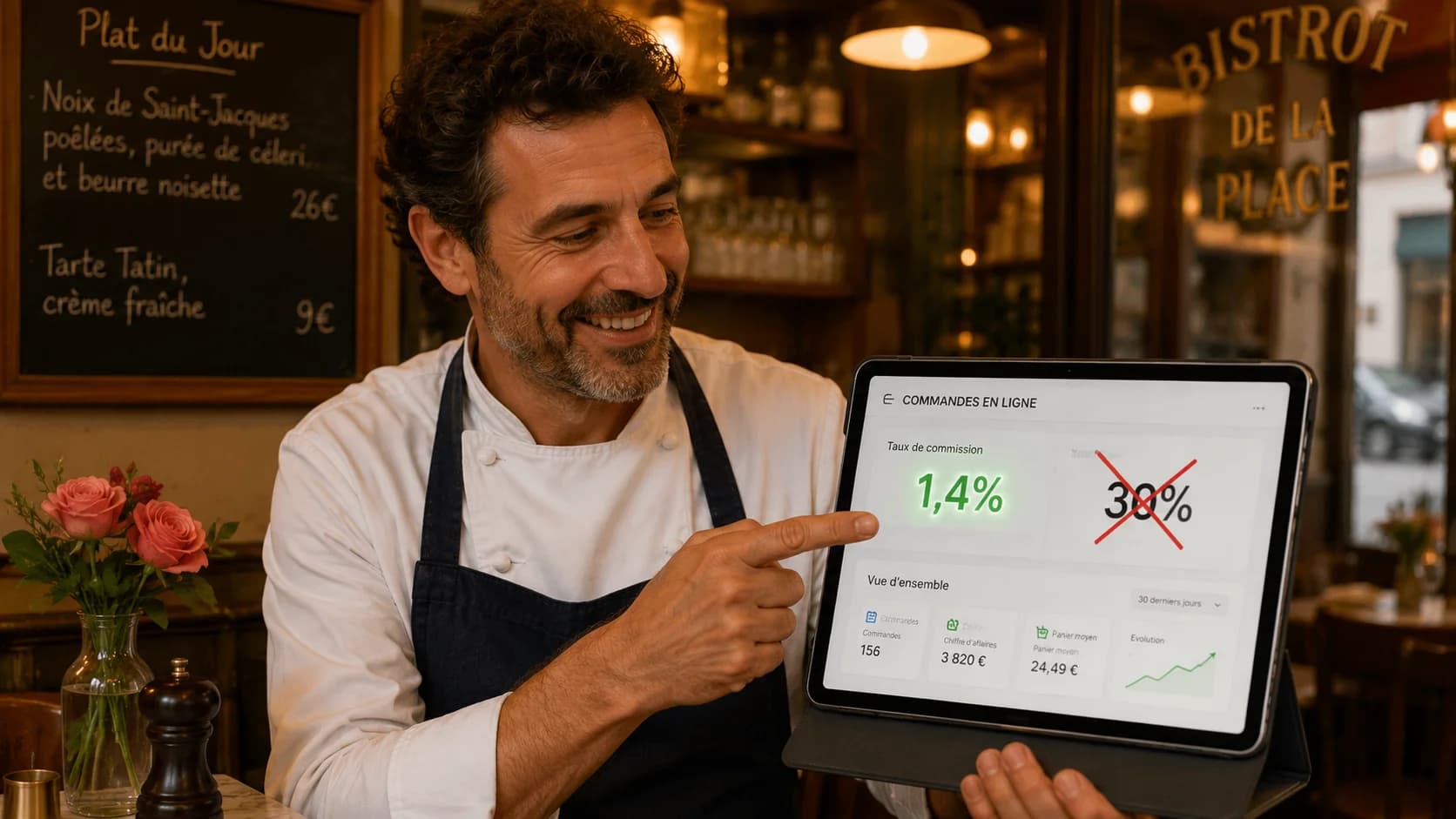
Every time a customer orders from you via Uber Eats or Deliveroo, you're working part of the evening for free. The platform collects the money, keeps the customer's contact details, keeps the review they'll leave, and sends you a bill with 30% less in it. In 2026, that model is no longer inevitable.
À retenir — Key Takeaways
- Commission saved: Uber Eats/Deliveroo 20–30% vs Stripe ~1.4% + €0.25 — on €5,000/month: €1,500 → €70 in fees, i.e. ~€1,400/month recovered
- Annual ROI: ~€17,000 saved in commissions for €5,000/month of online sales
- Loyalty: 300 regulars × 1 extra visit/month × €25 average basket = +€7,500/month in recurring revenue without spending on acquisition
- Customer behaviour: 9 out of 10 customers check the restaurant on their phone before coming — your site is your main shopfront
- Customer data: on a platform = the platform's property; on your site = yours (loyalty becomes possible)
- Payback: a direct ordering site pays for itself in a few weeks, not years
The Real Cost of Delivery Platforms
Delivery apps have one thing going for them: they bring volume. But they charge a steep price for it — and that price goes beyond the commission.
| Criterion | Platform (Uber Eats / Deliveroo) | Direct website |
|---|---|---|
| Commission per order | 20 to 30% | ~1.4% + €0.25 (Stripe) |
| Customer data | Owned by the platform | Yours |
| Customer reviews | Hosted by the platform | Yours |
| Loyalty | Almost impossible | Built-in programme |
| Net margin | Cut on every order | Preserved |
On a €30 order, the platform takes roughly €9. The same payment on your own website costs €0.67. Multiply by your monthly volume and the maths is undeniable.
The Numbers That Make the Decision
Take a restaurant doing €5,000 of online sales per month.
The gap is around €1,400 per month — nearly €17,000 per year. At that rate, a transactional website pays for itself in weeks, not years.
Why Your Website Has Become Non-Negotiable
Customer behaviour has shifted: 9 in 10 people check a restaurant on their phone before visiting. Menu, opening hours, booking, reviews. If what they find is slow, outdated or non-existent, they move on.
A modern website is therefore not a luxury: it is your main shopfront, open 24/7, that turns a Google search into a reservation or an order.
The Features That Actually Drive Revenue
Click & Collect with Real-Time Tracking
The customer orders, pays online, chooses a collection slot and receives a 4-digit code. In the kitchen, the order moves through three statuses visible to the customer: Received → Being prepared → Ready. No queue, no mistakes, no commission.
Automatic SMS Notifications
On top of the status shown on the site, an automatic SMS tells the customer as soon as their order is ready for pickup. This simple detail cuts down on trips to the dining room and phone calls ("is it ready?") that interrupt kitchen service — over a 50-order shift, this avoids 15 to 20 interruptions on average.
Anti-Waste Promotions in One Click
End of service with unsold stock? Activate a "last hour" or "today's leftover" promo (−20 to −50%) in a single click. The price updates live on the menu your customers see. You clear the stock instead of throwing it away — and attract bargain-hunters who become regulars.
Loyalty: The Most Underestimated Lever
Retaining a customer costs around 5 times less than acquiring a new one. A points programme (€1 = 1 point) with reward tiers — free coffee, dessert, dinner — gives regulars a concrete reason to come back.
The maths speaks for itself: if 300 regulars return one extra time per month at €25 average basket, that's +€7,500/month in recurring revenue — with zero acquisition spend.
Reviews and Social Proof
Online reviews and social proof can increase reservation rates by 30 to 50%. On your own website, those reviews belong to you and work for you — not for a platform.
Client Case: A Lille Bistro That Took Back Control
Le Petit Local, a 40-seat bistro in Old Lille, was generating around €4,200/month in takeaway orders through Uber Eats and Deliveroo combined in early 2026, at an average commission of 27% — roughly €1,134/month handed over to the platforms. In January 2026, the restaurant hired us to build a site with online ordering and integrated Stripe payment.
Project cost: €2,490 (the "Booking + ordering + payment" package), delivered in 3 weeks. The restaurant kept its platform accounts for visibility, but actively redirected its regular customers (QR code on tables, Instagram story, mention on the receipt) toward direct ordering.
Result after 4 months: 60% of takeaway order volume now goes through the direct site, bringing payment fees down to around €60/month for that share. The restaurant now recovers roughly €680/month that previously went to commissions — the project paid for itself in just under 4 months. The loyalty program built into the site also generated 85 active customer accounts by the second month, with zero additional ad spend.
Six Live Restaurant Demos
Here are demonstration sites we have actually built, each illustrating a different use case:
From a solo bistro to a franchise network, the same technical foundation scales to your size.
How Much Does It Cost?
We don't price a restaurant website like any other: it all depends on the features. Here are indicative ranges (the final quote depends on your needs):
| Level | What you get | Indicative range |
|---|---|---|
| Landing / simple showcase | Presentation, menu, contact | from ~€990 |
| Pro showcase | Custom design, gallery, booking | ~€1,490 to €2,490 |
| Booking + ordering + payment | Click & collect, Stripe, tracking | ~€2,990 to €3,990 |
| Loyalty + customer account | Points, tiers, customer portal | ~€4,990 to €7,990 |
| Network / franchise | Multi-site, franchise portal | on quote |
These figures are benchmarks. The best way to know your real budget is to request a personalised quote.
How to Switch Without Losing Volume
The transition doesn't happen overnight. The approach that works best for our restaurant clients follows three steps:
1. Weeks 1 to 3: the site goes live with a synchronised menu (same dishes, same prices as on the platforms, to avoid any customer confusion).
2. Weeks 4 to 8: communicating the switch — QR code on tables, Instagram story and post, mention on the receipt, possibly a welcome promo code ("-10% on your first direct order").
3. Month 3 onward: regulars naturally shift over once the habit is formed, while the platforms keep bringing in new customers who are discovering the restaurant.
Over this period, the restaurants we work with don't lose overall volume: they progressively redistribute their orders toward the most profitable channel, without ever cutting off the acquisition channel that the platforms represent.
Take Back Control
Handing over 30% to a platform on every order means financing someone else's growth with your kitchen. A direct website reverses the equation: your orders, your customers, your reviews, your margin — and every euro of that margin stays in your business instead of funding a platform's next marketing campaign.
Explore our dedicated packages on the restaurant websites page, discover our approach to custom web development, and when you're ready, request your free quote. In 2026, your best salesperson is your own website.
---
Further Reading
🍽️ NeuraWeb builds websites for restaurants: online booking, ordering & click & collect with Stripe payment, loyalty programme and multi-site management. Free quote within 24 hours. Get started →
Let’s discuss your project
30-min discovery call: ask your questions, we sketch a concrete first plan with rough numbers.
30 min · no commitment
Book a meetingRestaurant websites
Direct bookings, click & collect, loyalty: take back control of your commissions.
See the restaurant offer